
Southern Illinoise University Athletics
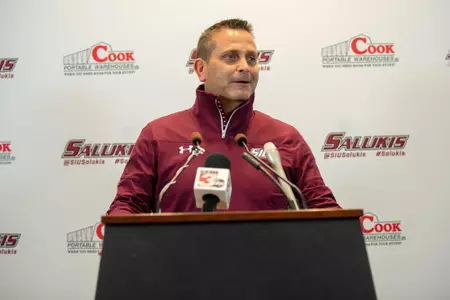
Salukis Athletics introduces Volleyball head coach Ed Allen
12/06/2018 | 6:44:00 | Women's Volleyball
CARBONDALE, Ill. — Saluki Athletics introduced Ed Allen as the new head coach of the volleyball program at Southern Illinois University during an afternoon press conference on Thursday at the Cook Club in SIU Arena. In 27 seasons as a head coach, Allen has compiled a 646-284 record, guided his team to six NCAA Tournament appearances, won nine conference championships and earned conference coach-of-the-year honors six times. In the last eight seasons at Alabama, Allen was 152-101, and the program made back-to-back NCAA tournament appearances in 2013 and 2014.
Director of Athletics Jerry Kill
Coaching is a difficult profession and sometimes you have to do things you don't want to do, but you have to move programs forward. From the volleyball standpoint, I think we moved our program more than forward. We hired Ed Allen a couple days ago. At Alabama, they've had five NCAA appearances, and he's had two of them, and you look at the track record of wins and losses and only one losing season. He's had a ton of success and he's perfect for what we need for our program right now. He's a guy who is known throughout the country and we're very fortunate to get a guy like Ed. I'd like to tell you I had everything to do with it, but I did not. I don't take credit where I don't deserve it. Ed is here because of Liz (Jarnigan). We went out and said we're going to get the best volleyball coach we can hire. Period. I told you all before — we're going to be a Division I program, we're going to win and we're going to bring in the best. That's what we did.
Senior Woman Administrator Liz Jarnigan
It's a privilege for me to be able to introduce Ed Allen to all of you today. I had no idea when I left the University of Tulsa years ago, that I would end up having the honor to work with him again. He is one of the best coaches I've ever worked with and I don't say that lightly. I can tell you that when we were together at the University of Tulsa, the athletic director there at the time was a man named Bubba Cunningham, who is currently the athletic director at North Carolina. Bubba and I had a conversation one day and he asked me, who do you think the best coach on our staff is? And I said I think it's Ed Allen. Bubba looked at me and said, "you're exactly right." That's the kind of person Ed is. I've been able to see first-hand how he can turn programs around and make them winners in a hurry. I'm just in awe, and respect him so much for the standards and values he embodies and instills in the programs that he leads. His record speaks for itself, for sure. Coach Kill talks a lot about Saluki Standards and the Culture of Champions, and from my own personal experience, I cannot think of anybody better than Ed Allen to come in and lead our volleyball program to be a Culture of Champions and to embody Saluki spirit.
Head Coach Ed Allen
Opening Statement
I'm excited to be here. Liz had everything to do with me being here. The experiences that we had together at Tulsa, the support she was able to provide the volleyball program there, I think really enticed me to take a look at this situation. Building is something I take a lot of enjoyment in. I've had the opportunity to take over four programs that needed that, and it excites me probably as much as anything. I'd like to hold a national championship trophy one day, but I know the excitement of building programs probably stokes my fire as much as anything. The opportunity to build this program into a winner, as it once was. We know it can be done here and we expect it to be done here. I'm a Midwest guy. I started coaching in Indiana, so the opportunity to get back into the Midwest is something that excites me a great deal. I love to fish and I love to spend time on lakes, and you've got a couple of those things around here, also. Coach Kill and Liz made it clear that we want to create a Culture of Champions and we want to support our athletic program here, and that's why I'm standing here today.
On what excites him about recruiting players to Southern Illinois.
The Missouri Valley is a really good mid-major volleyball conference. The ability to recruit Illinois, Indiana the Louisville area, the St. Louis area, I think it is geographically located in a perfect place to pull mid-major talent. We'll obviously stay in areas that we have relationships in, which is Texas and California and try to pull a kid occasionally from those areas. Our goal is to be able to recruit within a tank of gas, and we have a lot of good volleyball within a tank of gas.
On the difference between recruiting to a high-major school versus SIU.
When you're at a place like I was most recently at Alabama, you have an opportunity to recruit more of the country than what you have in certain mid-major positions. I think the challenges we had at various times at Alabama, when you're at a volleyball program in the South, volleyball is not very good in the South. If you look at my roster from the eight years I was at Alabama, I had a total of I think three kids from Alabama and nobody from a state that touched Alabama. I think it created different challenges than what a place like Southern Illinois does, because we have an opportunity to recruit not only very good talent within our state, but you can recruit every state that touches this state. It was a pretty big factor in deciding whether I wanted to come here and build this program.
On his coaching path.
The only job that I really applied for was the first coaching job that I had. I can remember running on a beach in Myrtle Beach one vacation and going, gosh how could anybody live in South Carolina, it's so hot and humid? About four years later I was living in South Carolina coaching. From there, University of Tulsa recruited me and the only thing I knew about Oklahoma was Grapes of Wrath, so I never thought about living in Oklahoma either. So Alabama came after and recruited me and I hadn't thought about living in the deep South. I think life has a way of opening doors. I am a very spiritual person as well, and I think I'll be at Southern Illinois until the Dear Lord says it's time to go somewhere else.
On how long he plans to be in coaching.
I have a passion to coach. If you look at what happened to Coach (Bear) Bryant, he quit coaching and about six months later he died. I think I'm probably going to be that person. I'm a coach by nature. The goal I have in life is to make the world a better place, and my goodness, how can you do that any better than in a coaching profession where you're surrounded by doctors, lawyers, school teachers, social workers and people who are going to go out into a variety of occupations and influence the world? I'm not sure, outside of a minister, there are occupations that have the ability to influence the world as dramatically as what we have a chance to do in the coaching profession.
On working with the current roster.
These are kids, whether I recruited them or not, my goal is still the same, is to make them everything they're capable of being and influence them in such a way that they make the world a better place. You create a certain degree of expectation of them, you are honest about what that expectation is, and you help create a structure that allows them to become successful — that's in the classroom, on the court and in the community. We'll spend a lot of time in this first spring together really creating a framework that allows them to be successful.
On why he left Alabama.
It was a situation where I'd worked for three athletic directors in an eight-year period of time and we'd gone through four presidents in that same period of time. I felt like we'd reached a ceiling with what we were capable of accomplishing and had a conversation about that. In that conversation, I felt like it was a great time to allow one of my assistants to have an opportunity to finish things.
On the importance of facilities.
I know that facilities are a big part of what allows teams to build and be successful, but not everything is tied up in brick and mortar, either. The reality is you have an opportunity to build a program, and it's built in a variety of ways.
On the timeframe for turning around SIU's program.
In my experiences building it at every level, it is an easier accomplishment at a mid-major school than it is at the top of the pyramid. It's getting easier because we've gotten recruiting rules in place that you're not recruiting kids in eighth grade anymore, you're recruiting kids that are juniors who can travel to the institution and be able to take official visits. I think the goal for all of us as coaches is to slow down the recruiting process. I think it's in the best interest of everyone. I'm not really good at being able to evaluate how good a kid is going to be at age 13, and that's about where we were at under the old structure. I think we're cheating kids when we're asking them to make commitments when they're 14 years old about where they want to go to college.
On the process for turning around a program.
You get up every day trying to figure out how you can be the best person, the best coach. I get up every day thinking first of all, how can I be the best husband and father I can be? Everything evolves from there. When I think about my players, how can I be the best coach to those players? I don't serve, set, pass and dig balls — my players do. The ability to support them and create a structure that allows them to be successful is important.
On his team's style of play.
I think it has a lot to do with what my personnel is. You're going to see an effort level that's not going to have kids giving up on a ball until the official blows a whistle. I'd like to think we're a good defensive team at every stop I've been in. You can beat a lot of people by just wearing them out, frustrating them in such a way that you force errors.
On what he looks for in recruits.
One of the things I used to ask for a number of years was, have you ever had a job? Obviously, there's fewer and fewer kids who have that, because we're in a different place in the world. Some of the best players I've ever had, and I've had five of them in this category, were farm girls. They grew up on a farm and knew what it was like to get up at five o'clock and have chores to do, whether they were sick or not sick. The ability to have a level of expectation placed on you at an early age, I think jobs do that. So what do I look for? I look for people who have had some degree of responsibility to a certain point and in the recruiting process be able to communicate what our expectations are, what we're looking for in players, what we'd expect of you in the four years you're at an institution. Try to find kids that are committed to excellence, and I think the first place you locate that is, what kind of student are they? They don't have to be a 4.0 student, but I think we're all capable of being better than average at what we do. I think you start with the report card and try to figure out what's important to them.
Director of Athletics Jerry Kill
Coaching is a difficult profession and sometimes you have to do things you don't want to do, but you have to move programs forward. From the volleyball standpoint, I think we moved our program more than forward. We hired Ed Allen a couple days ago. At Alabama, they've had five NCAA appearances, and he's had two of them, and you look at the track record of wins and losses and only one losing season. He's had a ton of success and he's perfect for what we need for our program right now. He's a guy who is known throughout the country and we're very fortunate to get a guy like Ed. I'd like to tell you I had everything to do with it, but I did not. I don't take credit where I don't deserve it. Ed is here because of Liz (Jarnigan). We went out and said we're going to get the best volleyball coach we can hire. Period. I told you all before — we're going to be a Division I program, we're going to win and we're going to bring in the best. That's what we did.
Senior Woman Administrator Liz Jarnigan
It's a privilege for me to be able to introduce Ed Allen to all of you today. I had no idea when I left the University of Tulsa years ago, that I would end up having the honor to work with him again. He is one of the best coaches I've ever worked with and I don't say that lightly. I can tell you that when we were together at the University of Tulsa, the athletic director there at the time was a man named Bubba Cunningham, who is currently the athletic director at North Carolina. Bubba and I had a conversation one day and he asked me, who do you think the best coach on our staff is? And I said I think it's Ed Allen. Bubba looked at me and said, "you're exactly right." That's the kind of person Ed is. I've been able to see first-hand how he can turn programs around and make them winners in a hurry. I'm just in awe, and respect him so much for the standards and values he embodies and instills in the programs that he leads. His record speaks for itself, for sure. Coach Kill talks a lot about Saluki Standards and the Culture of Champions, and from my own personal experience, I cannot think of anybody better than Ed Allen to come in and lead our volleyball program to be a Culture of Champions and to embody Saluki spirit.
Head Coach Ed Allen
Opening Statement
I'm excited to be here. Liz had everything to do with me being here. The experiences that we had together at Tulsa, the support she was able to provide the volleyball program there, I think really enticed me to take a look at this situation. Building is something I take a lot of enjoyment in. I've had the opportunity to take over four programs that needed that, and it excites me probably as much as anything. I'd like to hold a national championship trophy one day, but I know the excitement of building programs probably stokes my fire as much as anything. The opportunity to build this program into a winner, as it once was. We know it can be done here and we expect it to be done here. I'm a Midwest guy. I started coaching in Indiana, so the opportunity to get back into the Midwest is something that excites me a great deal. I love to fish and I love to spend time on lakes, and you've got a couple of those things around here, also. Coach Kill and Liz made it clear that we want to create a Culture of Champions and we want to support our athletic program here, and that's why I'm standing here today.
On what excites him about recruiting players to Southern Illinois.
The Missouri Valley is a really good mid-major volleyball conference. The ability to recruit Illinois, Indiana the Louisville area, the St. Louis area, I think it is geographically located in a perfect place to pull mid-major talent. We'll obviously stay in areas that we have relationships in, which is Texas and California and try to pull a kid occasionally from those areas. Our goal is to be able to recruit within a tank of gas, and we have a lot of good volleyball within a tank of gas.
On the difference between recruiting to a high-major school versus SIU.
When you're at a place like I was most recently at Alabama, you have an opportunity to recruit more of the country than what you have in certain mid-major positions. I think the challenges we had at various times at Alabama, when you're at a volleyball program in the South, volleyball is not very good in the South. If you look at my roster from the eight years I was at Alabama, I had a total of I think three kids from Alabama and nobody from a state that touched Alabama. I think it created different challenges than what a place like Southern Illinois does, because we have an opportunity to recruit not only very good talent within our state, but you can recruit every state that touches this state. It was a pretty big factor in deciding whether I wanted to come here and build this program.
On his coaching path.
The only job that I really applied for was the first coaching job that I had. I can remember running on a beach in Myrtle Beach one vacation and going, gosh how could anybody live in South Carolina, it's so hot and humid? About four years later I was living in South Carolina coaching. From there, University of Tulsa recruited me and the only thing I knew about Oklahoma was Grapes of Wrath, so I never thought about living in Oklahoma either. So Alabama came after and recruited me and I hadn't thought about living in the deep South. I think life has a way of opening doors. I am a very spiritual person as well, and I think I'll be at Southern Illinois until the Dear Lord says it's time to go somewhere else.
On how long he plans to be in coaching.
I have a passion to coach. If you look at what happened to Coach (Bear) Bryant, he quit coaching and about six months later he died. I think I'm probably going to be that person. I'm a coach by nature. The goal I have in life is to make the world a better place, and my goodness, how can you do that any better than in a coaching profession where you're surrounded by doctors, lawyers, school teachers, social workers and people who are going to go out into a variety of occupations and influence the world? I'm not sure, outside of a minister, there are occupations that have the ability to influence the world as dramatically as what we have a chance to do in the coaching profession.
On working with the current roster.
These are kids, whether I recruited them or not, my goal is still the same, is to make them everything they're capable of being and influence them in such a way that they make the world a better place. You create a certain degree of expectation of them, you are honest about what that expectation is, and you help create a structure that allows them to become successful — that's in the classroom, on the court and in the community. We'll spend a lot of time in this first spring together really creating a framework that allows them to be successful.
On why he left Alabama.
It was a situation where I'd worked for three athletic directors in an eight-year period of time and we'd gone through four presidents in that same period of time. I felt like we'd reached a ceiling with what we were capable of accomplishing and had a conversation about that. In that conversation, I felt like it was a great time to allow one of my assistants to have an opportunity to finish things.
On the importance of facilities.
I know that facilities are a big part of what allows teams to build and be successful, but not everything is tied up in brick and mortar, either. The reality is you have an opportunity to build a program, and it's built in a variety of ways.
On the timeframe for turning around SIU's program.
In my experiences building it at every level, it is an easier accomplishment at a mid-major school than it is at the top of the pyramid. It's getting easier because we've gotten recruiting rules in place that you're not recruiting kids in eighth grade anymore, you're recruiting kids that are juniors who can travel to the institution and be able to take official visits. I think the goal for all of us as coaches is to slow down the recruiting process. I think it's in the best interest of everyone. I'm not really good at being able to evaluate how good a kid is going to be at age 13, and that's about where we were at under the old structure. I think we're cheating kids when we're asking them to make commitments when they're 14 years old about where they want to go to college.
On the process for turning around a program.
You get up every day trying to figure out how you can be the best person, the best coach. I get up every day thinking first of all, how can I be the best husband and father I can be? Everything evolves from there. When I think about my players, how can I be the best coach to those players? I don't serve, set, pass and dig balls — my players do. The ability to support them and create a structure that allows them to be successful is important.
On his team's style of play.
I think it has a lot to do with what my personnel is. You're going to see an effort level that's not going to have kids giving up on a ball until the official blows a whistle. I'd like to think we're a good defensive team at every stop I've been in. You can beat a lot of people by just wearing them out, frustrating them in such a way that you force errors.
On what he looks for in recruits.
One of the things I used to ask for a number of years was, have you ever had a job? Obviously, there's fewer and fewer kids who have that, because we're in a different place in the world. Some of the best players I've ever had, and I've had five of them in this category, were farm girls. They grew up on a farm and knew what it was like to get up at five o'clock and have chores to do, whether they were sick or not sick. The ability to have a level of expectation placed on you at an early age, I think jobs do that. So what do I look for? I look for people who have had some degree of responsibility to a certain point and in the recruiting process be able to communicate what our expectations are, what we're looking for in players, what we'd expect of you in the four years you're at an institution. Try to find kids that are committed to excellence, and I think the first place you locate that is, what kind of student are they? They don't have to be a 4.0 student, but I think we're all capable of being better than average at what we do. I think you start with the report card and try to figure out what's important to them.
Saluki Radio Baseball Broadcast - At UE Game Three (Audio Only)
Sunday, April 12
Saluki Radio Baseball Broadcast - At UE Game Two (Audio Only)
Sunday, April 12
Saluki Radio Baseball Broadcast - at UE Game 1 (Audio Only)
Saturday, April 11
4.9.26 | Baseball Weekend Preview - at Evansville
Thursday, April 09