


Southern Illinoise University Athletics
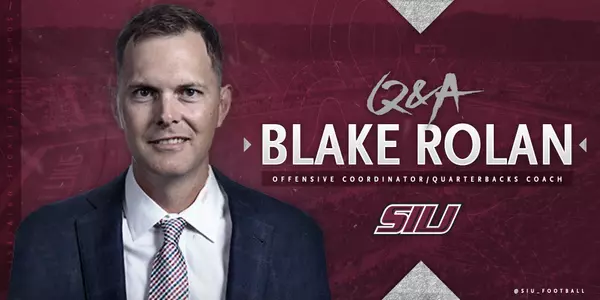
Q & A with new Salukis' offensive coordinator Blake Rolan
01/22/2019 | 3:41:00 | Football
CARBONDALE, Ill. — New Salukis' offensive coordinator and quarterbacks coach Blake Rolan talks about his coaching career, philosophy and what attracted him to Southern Illinois. During coaching stops at Tennessee and Cincinnati, Rolan coached seven wide receivers who went on to play in the National Football League (Cordarrelle Paterson – New England Patriots, Justin Hunter – Buffalo Bills, Da'Rick Rogers – Indianapolis Colts, Denarius Moore – Oakland Raiders, Chris Moore – Baltimore Ravens, Johnny Holton – Oakland Raiders, Mekale McKay – Chicago Bears).
Who are the coaches who have influenced your career the most?
I've been fortunate to be around a lot of good ones. My high school coach, Jerry Sharp, is a Hall of Fame high school coach in Georgia and really instilled qualities such as work ethic, selflessness and discipline. It started there and it's probably why I got into the profession. Once I got into college coaching, the biggest ones were Jim Chaney and Derek Dooley at Tennessee for three seasons. Derek, having a lawyer's background, made you come prepared every day. If you had opinions, you'd better be able to back it up with some evidence. Jim Chaney is a grinder, very detailed, and required you to be on your toes every day. I learned a lot watching film with him and it prepared me with a solid foundation in coaching.
You were a walk-on quarterback at Middle Tennessee State and eventually earned a scholarship. How did that experience benefit your coaching career?
It teaches you a lot when you walk-on at a program. You can't have an off-day. You have to out-work people and stand out with your work ethic and what you do on and off the field. It was good for me to set a goal and then achieve it, and now as a coach, you have all-types of players — big-time players and guys who walk on — you can relate to all of them and understand what they're going through and help them achieve their goals.
 What's the most rewarding aspect of coaching?
When you see a change in a positive way over the course of two, three, four years. I coached high school football for a little while when I was finishing up undergrad and working for a bank. That was my first taste of it, seeing these young guys develop as an eighth or ninth grader and seeing what it does to their whole life, the confidence it gives them, the growth of a freshman to a senior, you could see that change and development in a young man. In college, I see the same in young men who want to be coached, want to have some sort discipline in their life. That's the gratification and why I originally got into coaching, you see the impact a coach has. In college football, you have to be with them in all walks of life — academics, social life, on the field.
A couple guys at Cincinnati when I first walked in the doors, the coaches from the previous staff had some negative things to say about them as freshmen. I figured out early that a lot of freshmen have issues in college, but it was unbelievable to see what a fresh, clean slate did for them. To see a young man grow in all aspects of his life and develop into an All-Conference player and go to the Combine, and play at the next level. More importantly, to see them develop into a man over the course of three or four years, see them get married. That's why we do this.
What are some of your favorite success stories?
Chris Moore was a guy from Jefferson High School in Tampa, Florida and is now with the (Baltimore) Ravens. He and Shaq Washington were two kids who when we got to Cincinnati were about to leave the team. Shaq was a guy who had a freshman year filled with turbulence, and to see him end up in three years break every school record receiving-wise, and be in the Hall of Fame now at Cincinnati, and be a high school coach and win Coach of the Year his first year as head coach. It's gratifying. We had a kid named Johnny Holton, who had never played high school football and had a pretty rough upbringing and is now playing for the Oakland Raiders. To see him get a degree — those are the moments you never forget. You don't remember every play or all the catches and touchdowns, but you remember the moments they call to say, hey, I had a child, or invite you to their wedding.
Your first job was with Auburn and you also coached at Kentucky — what was it like to coach in the SEC?
It was definitely jumping into the deep end at Auburn as a GA. Every day is competition and every week is a fight. When you play against Alabama in the Iron Bowl and you see them start tailgating on Wednesday. As coaches, it holds you to a high standard. The background noise at that level, whether you're having positive or negative years, teaches you to really focus on what matters. You don't spend much time listening to the radio or on social media. First, you don't have time to do that, you're pretty much working all day and night, so you don't hear a ton of noise. You have to remind your family members to stay the course and not get caught up in all the other things. It requires an intensity on a daily basis to bring your best because there's no off weeks.
How did you meet Coach Hill?
I was visiting a good friend of mine in Los Angeles — Rams quarterback coach Zac Taylor — who is a mutual friend of Coach Hill's. That's when I first met Coach Hill at OTAs (NFL's Organized Team Activities) last spring. I was staying with Zac and his wife and family and recruiting a little bit, and Coach Hill and his wife came over. We spent a couple days in the office just watching the Rams, doing some professional development-type stuff. I ended up talking with Coach Hill and carrying on that relationship over our season. After the season, he gave me a phone call and told me what was going on here and asked me if I'd be interested.
What sold you on coming to Southern Illinois?
It was a no-brainer. Just in the couple days we spent together, we were talking the same language offensively. I got to meet his wife and hear about his family, came in and met the people, saw the facilities, and it just seemed like a good situation. I feel like we have a good recruiting base, can do some good things within a 3-4 hour radius. I had a chance to meet Coach Kill. I think there are very few athletic directors who get it like he does. Obviously, being a successful coach, but having a passion for this place, you can see that, you can feel that when you're around him. You don't get that in college football. You don't get someone who really wants to make it right and do it the best he can do, not just so he can get the next job. That situation is unique. I've been a lot of places and it's not like any other place that I've been. You can see the opportunity here with people who want to do it right and win. It seems like everyone is pulling together.
How will you integrate your ideas with the offense that's already in place at SIU?
When I look at the concepts they're using here, it's very similar to what I've been doing. I talked about Jim Chaney at Tennessee — I feel like I've been a part of creating an offense from that ground floor, seven, eight years ago and developing it through Cincinnati and through what we did at Dixie State. I feel like there will be some ideas I can bring in certain passing-game situations, RPOs (Run-Pass Options) that we've had success with, hopefully I can help improve parts of the offense. They've done a good job here scoring points and doing things well, but I feel like I'll bring a different outside-look perspective and the ability to analytically back up some things and show some other ways to do it.
Have you had a chance to see much film of SIU from last year?
I've had a chance to pull up some cut-ups of three or four games. The most exciting thing is you're getting a lot of good players back. That's huge. They're right there. They had the lead in the majority of games. You see players who have the ability to do some good things. You have to sharpen it up and be a little bit more detailed in certain situations, but it's exciting. Offensively and defensively, I'm not coming into a place that has to restart or rebuild. These guys here recruited well, have good players. It's time to clean a couple things up and help our kids learn how to overcome and win and finish games.
What is your top priority between now and the start of spring ball in six weeks?
I have to build relationship with these quarterbacks, spend some quality time with them, and find out what motivates them, what doesn't motivate them. Coaching is developing those relationships with your players and figuring out what will help them improve the most. You get on the board and watch some film, eat dinner, and have that tight relationship. That's when you see the biggest growth — when a young man trusts you. As a coach, you have to earn that and build that. I want to build relationships with all of the players on offense so when we get into spring ball, I can coach them hard, but also love them hard afterward. It's a great opportunity, a great time to be here.
Who are the coaches who have influenced your career the most?
I've been fortunate to be around a lot of good ones. My high school coach, Jerry Sharp, is a Hall of Fame high school coach in Georgia and really instilled qualities such as work ethic, selflessness and discipline. It started there and it's probably why I got into the profession. Once I got into college coaching, the biggest ones were Jim Chaney and Derek Dooley at Tennessee for three seasons. Derek, having a lawyer's background, made you come prepared every day. If you had opinions, you'd better be able to back it up with some evidence. Jim Chaney is a grinder, very detailed, and required you to be on your toes every day. I learned a lot watching film with him and it prepared me with a solid foundation in coaching.
You were a walk-on quarterback at Middle Tennessee State and eventually earned a scholarship. How did that experience benefit your coaching career?
It teaches you a lot when you walk-on at a program. You can't have an off-day. You have to out-work people and stand out with your work ethic and what you do on and off the field. It was good for me to set a goal and then achieve it, and now as a coach, you have all-types of players — big-time players and guys who walk on — you can relate to all of them and understand what they're going through and help them achieve their goals.
What's the most rewarding aspect of coaching?When you see a change in a positive way over the course of two, three, four years. I coached high school football for a little while when I was finishing up undergrad and working for a bank. That was my first taste of it, seeing these young guys develop as an eighth or ninth grader and seeing what it does to their whole life, the confidence it gives them, the growth of a freshman to a senior, you could see that change and development in a young man. In college, I see the same in young men who want to be coached, want to have some sort discipline in their life. That's the gratification and why I originally got into coaching, you see the impact a coach has. In college football, you have to be with them in all walks of life — academics, social life, on the field.
A couple guys at Cincinnati when I first walked in the doors, the coaches from the previous staff had some negative things to say about them as freshmen. I figured out early that a lot of freshmen have issues in college, but it was unbelievable to see what a fresh, clean slate did for them. To see a young man grow in all aspects of his life and develop into an All-Conference player and go to the Combine, and play at the next level. More importantly, to see them develop into a man over the course of three or four years, see them get married. That's why we do this.
What are some of your favorite success stories?
Chris Moore was a guy from Jefferson High School in Tampa, Florida and is now with the (Baltimore) Ravens. He and Shaq Washington were two kids who when we got to Cincinnati were about to leave the team. Shaq was a guy who had a freshman year filled with turbulence, and to see him end up in three years break every school record receiving-wise, and be in the Hall of Fame now at Cincinnati, and be a high school coach and win Coach of the Year his first year as head coach. It's gratifying. We had a kid named Johnny Holton, who had never played high school football and had a pretty rough upbringing and is now playing for the Oakland Raiders. To see him get a degree — those are the moments you never forget. You don't remember every play or all the catches and touchdowns, but you remember the moments they call to say, hey, I had a child, or invite you to their wedding.
Your first job was with Auburn and you also coached at Kentucky — what was it like to coach in the SEC?
It was definitely jumping into the deep end at Auburn as a GA. Every day is competition and every week is a fight. When you play against Alabama in the Iron Bowl and you see them start tailgating on Wednesday. As coaches, it holds you to a high standard. The background noise at that level, whether you're having positive or negative years, teaches you to really focus on what matters. You don't spend much time listening to the radio or on social media. First, you don't have time to do that, you're pretty much working all day and night, so you don't hear a ton of noise. You have to remind your family members to stay the course and not get caught up in all the other things. It requires an intensity on a daily basis to bring your best because there's no off weeks.
How did you meet Coach Hill?
I was visiting a good friend of mine in Los Angeles — Rams quarterback coach Zac Taylor — who is a mutual friend of Coach Hill's. That's when I first met Coach Hill at OTAs (NFL's Organized Team Activities) last spring. I was staying with Zac and his wife and family and recruiting a little bit, and Coach Hill and his wife came over. We spent a couple days in the office just watching the Rams, doing some professional development-type stuff. I ended up talking with Coach Hill and carrying on that relationship over our season. After the season, he gave me a phone call and told me what was going on here and asked me if I'd be interested.
What sold you on coming to Southern Illinois?
It was a no-brainer. Just in the couple days we spent together, we were talking the same language offensively. I got to meet his wife and hear about his family, came in and met the people, saw the facilities, and it just seemed like a good situation. I feel like we have a good recruiting base, can do some good things within a 3-4 hour radius. I had a chance to meet Coach Kill. I think there are very few athletic directors who get it like he does. Obviously, being a successful coach, but having a passion for this place, you can see that, you can feel that when you're around him. You don't get that in college football. You don't get someone who really wants to make it right and do it the best he can do, not just so he can get the next job. That situation is unique. I've been a lot of places and it's not like any other place that I've been. You can see the opportunity here with people who want to do it right and win. It seems like everyone is pulling together.
How will you integrate your ideas with the offense that's already in place at SIU?
When I look at the concepts they're using here, it's very similar to what I've been doing. I talked about Jim Chaney at Tennessee — I feel like I've been a part of creating an offense from that ground floor, seven, eight years ago and developing it through Cincinnati and through what we did at Dixie State. I feel like there will be some ideas I can bring in certain passing-game situations, RPOs (Run-Pass Options) that we've had success with, hopefully I can help improve parts of the offense. They've done a good job here scoring points and doing things well, but I feel like I'll bring a different outside-look perspective and the ability to analytically back up some things and show some other ways to do it.
Have you had a chance to see much film of SIU from last year?
I've had a chance to pull up some cut-ups of three or four games. The most exciting thing is you're getting a lot of good players back. That's huge. They're right there. They had the lead in the majority of games. You see players who have the ability to do some good things. You have to sharpen it up and be a little bit more detailed in certain situations, but it's exciting. Offensively and defensively, I'm not coming into a place that has to restart or rebuild. These guys here recruited well, have good players. It's time to clean a couple things up and help our kids learn how to overcome and win and finish games.
What is your top priority between now and the start of spring ball in six weeks?
I have to build relationship with these quarterbacks, spend some quality time with them, and find out what motivates them, what doesn't motivate them. Coaching is developing those relationships with your players and figuring out what will help them improve the most. You get on the board and watch some film, eat dinner, and have that tight relationship. That's when you see the biggest growth — when a young man trusts you. As a coach, you have to earn that and build that. I want to build relationships with all of the players on offense so when we get into spring ball, I can coach them hard, but also love them hard afterward. It's a great opportunity, a great time to be here.
4.30.26 | Saluki Baseball Weekend Preview- Indiana State
Thursday, April 30
Saluki Radio Baseball Broadcast - Murray State Game 3 (Audio Only)
Monday, April 27
4.23.26 | Saluki Baseball Weekend Preview - Murray State
Thursday, April 23
Saluki Radio Baseball Broadcast - at Bradley Game Three (Audio Only)
Sunday, April 19