Southern Illinoise University Athletics
Brazilian Natives Contribute To SIU's Swimming Success
11/18/2003 | 12:00:00 | Swimming & Diving
Nov. 18, 2003
CARBONDALE, Ill.
By Dave Siegal
www.SIUSalukis.com - This year's Saluki swimming and diving teams include athletes from as close as Carbondale to as far away as Hungary, Greece, South Africa and Brazil. A total of four people between the men's and women's teams are from Brazil - men's swimmers Marcelo Possato and Edoardo Daelli and women's swimmer Karina Belache. Men's assistant coach Gustavo Leal is also from Brazil and was in his first year as an assistant when Daelli and Belache entered SIU in 2000-2001. Possato came a year later.
Edoardo Daelli, and senior, comes from Sao Paulo, Brazil where he competed in the Brazilian Junior nationals at the Colegio Arquidiocesano. Yet, Daelli says the professors in his home country could care less about his accomplishments and his coaches feel the same when it came to his school work.
"The big difference in America is that swimming and going to school is integrated. In Brazil, if you want to go to college and swim, it's much harder," Daelli said. "The colleges don't have teams. Even with the teachers understanding that you have practice and you have to miss a class. No, if you have to miss a class because of a meet, they won't care. In Brazil, your coaches won't care that you have school. If you swim in a club and go to college, each coach or professor wants you to do their stuff and they're not related. Here at SIU, they are related."
Daelli says that former Saluki Danilo Luna, who graduated last year, was instrumental in bringing him to Carbondale four years ago and Daelli now enjoys being a leader.
"It's a good experience. It's nice to have some people looking up at you, at what you're doing and trying to do the same," Daelli said. "Younger people look up at the seniors, so I try to set an example as much as I can. It's hard for foreign students - the culture, the language and other stuff like that so going over obstacles, you can tell them what's inevitible. Since it's harder for international people to be here in the first place, you have a better view of how hard it is to get here and to be here. It's easier to set an example to the other people."
Men's assistant swimming coach, Gustavo Leal, or "Goose" as many call him, came to SIU almost by accident. At Indian River Community College where he was a two time JUCO national champion, Leal was friends with former Saluki standout Herman Lauw. When men's head coach, Rick Walker was recruiting Lauw, Leal was also reccomended to him. Walker took Leal under his wing.
"Rick was the only coach that took care of me," Leal said. "So that was a big part of my decision to come here and I like Carbondale. It was a good scholarship. The team was good and so were the facilities. I visited bigger schools, but I felt SIU and Carbondale was the best place for me."
At SIU, Leal was on the 1999 SIU men's MVC championship team, and was a member of the championship 200 and 800-yard freestyle relay teams, as well as being named all-MVC in 1999 and 2000 in both events. When he became an assistant coach immediately after graduating in 2001, Leal's training helped the Salukis to regain the MVC championship in 2002.
Besides Rick, Goose helped me a lot to come here," Possato said. "All the things I asked him, he knew the answer."
Possato, a junior from Rio de Janerio, Brazil, wears a Superman logo on his swim cap and is making every effort he can to reach that level. As a freshman, he swam the lead leg of the championship and record-breaking 400 medley (3:19.71). Previously, he was a five-time Brazilian junior champion in the 200-yard backstroke from 1996-2001.
"That was amazing for me," Possato said about breaking the record. "I came here with a lot of expectations and to beat a record my freshman year, a relay one, was a really great start for me. I liked it a lot."
"My expectations are pretty high," Possato adds. "Last year, I beat the MVC record and this year, I think I could break the record again. I'm working really hard this year too, much harder than last year. I just have good expectations each year, and each year I raise the bar. Mentally, you need to work as hard as your body in swimming."
It was hard at first for Possato to fit into America, but his Brazilian teammates and Coach Leal made him comfortable.
"At the beginning, it was kind of tough because I never came to the United States before so I didn't know what to expect," Possato said. "My English was really bad my freshman year. When I came here everything was new, but in a good way. I started practicing my English more and started studying, and I really enjoyed practicing here too. Things started getting easier for me."
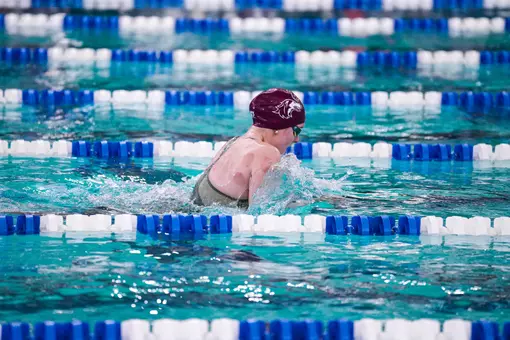
Senior freestyle swimmer Karina Belache is the lone female Brazilian, but she uses her freedom to garner achievements. These achievements include making all-MVC in the 100-yard fly as a freshman and posting a career best 58:09 in the 100 fly at the 2002 MVC Championships. In her hometown of Rio de Jameiro, Belache placed third in the 100 fly at the 2000 Open Brazilian Nationals and was a member of the 1999 Brazilian National Team, finishing sixth in the 100 fly at the World Cup.
Like her fellow Brazilians, Belache struggled to adjust to a new culture. Women's head coach Jeff Goelz and Leal helped Belache settle in.
"Even before I knew Jeff, I was so excited to swim for him because he was so cool," Belache said. "Every time I first spoke with Jeff on the phone, my English wasn't good at all so Goose had to get on the phone and talk to me. It was very nice because I couldn't start school my first semester becasue I had all these problems with grades and SATs because of a translation problem in Brazil. Goose was the one that helped me through this, so I took the SAT again and passed it."
Belache also credits the grind of practice and the season in helping her improve.
"It's very hard and a lot of work. Sometimes if you mess up one turn or one part, you just lost all your work that you did for the semester," Belache said. "It's 5:30 in the morning every day, every afternoon, and the travel. I learned how to race more often because we race every weekend here and it wasn't like this in Brazil. I got stronger too in the waist and it helped my time."
"Goose is the best. He really helped me," Belache adds. "When I had some trouble with my sets, I came to him. First I go to Jeff, and if I can't understand him I go to Goose because he speaks my language and he can explain it better."
Having four Brazilians between the two teams makes communication easier on everyone and creates a more comfortable environment for those athletes from other countries.
"It's nice to have somebody from your own country here. I get to speak Portugeese a lot and they're good swimmers," Leal said. "They're a big part of this team. We like to have international swimmers on the team all the time. In my case, I like to have Brazilians."
"It's an easier transition for them coming from Brazil or another country, especially because I went through what they are going through right now. I can explain to them and I guess they are comfortable having somebody here from their own country that has been through everything that they are going through," Daelli adds. "It gives you a home feeling and people to talk Portugeese to, which is always good. You have people that know what's going on in Brazil, the stuff we used to do there and can translate it here and make you adapt better."
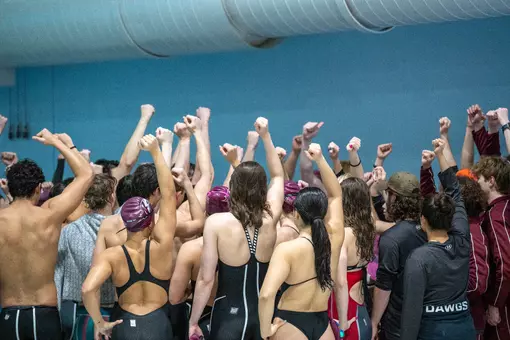
Although this contingent of swimmers are close-knit, they describe their relationship with the team as a whole as a tight family.
"It's nice to be able to meet people from around the world and see what goes on in other places. How they swim there, how their practices are, how their culture and politics work," Daelli said. "Being able to meet people from different cultures and being able to listen to their experiences of situations that we go through here, sometimes they have better ideas of what we go through here, what can be different and what they did at home that they don't do here."
"Back home, I don't see Ed a lot because he's from Sao Paulo and I'm from Rio, but when we're here we feel like family," Possato said. "Not just him, the entire team. It's kind of strange because we just see the coaches in here, not outside the pool. Back home we can meet our coach socially, but here it's only in the pool. Here it is much more professional, so I like that."
Belache also takes pride in being part of a diverse team.
"It's pretty cool because it's just brings something different. Our countries practice differently, be it Brazil, South Africa or Hungary, so we bring different sets to the team. It's fun. I don't think I'd be here if I didn't have them with me. It would be to hard, they help me a lot," Belache said.
Despite the trouble adjusting to another country, this group will have fond memories of their time in America, whether they remain or not. Daelli plans to remain in the U.S. for about five to 10 years depending on whether he gets a job in his major (computer engineereing).
"The most important reason I came to the U.S. is because I wanted to go to a good school and keep swimming. A scholarship helps a lot," Daelli said. "I like the friends I've made here, the swimming program. That's the reason why I'm here, so I like that the most about it."
Belache feels with an American degree, it may be easier for her to find a job with her English. She might remain in the United States for a couple of years, then plans to go back and be around her family. With a year to spare, Possato says he still has to decide.
"It's an experience that I'll remember my entire life, I don't regret anything," Possato said. "If I had to do it all over again, I would do it. I came here to improve my swimming and to get a good degree."
"I like everything here, all the people are warm," Possato adds. "Academically I have no problems at all. I'm just thankful Goose called me to come here."
Whenever people at SIU think of Brazil, they can think of three successful swimmers and a former swimmer who became a successful coach.